TL;DR: Published estimates put a planner at about 10 to 25 weddings a year, but the yearly total is the wrong limit. In Greater Victoria, 55% of 2025’s 2,104 weddings fell in June to September. Your real number is what your team can carry on 17 peak Saturdays, so set it, and plan the overflow, before January.
How many weddings can a wedding planner do a year? Published estimates say 10 to 25, depending on experience Outside source. That number hides the real problem. In Greater Victoria, 1,155 of 2025’s 2,104 weddings fell in four months Our analysis. Those weeks set your limit. It comes down to the Saturdays you can staff, the hours each wedding takes, and where the overflow goes.
How many weddings can a wedding planner do in a year?
Published estimates run from about 10 to 15 full-service weddings a year for a newer planner to 18 to 25 for an experienced one Outside source. Those figures come from the Wedding Planning Institute’s 2026 salary guide, which states no method, so treat them as a starting point. The same guide estimates the hours each kind of wedding takes.
| Service | Hours per wedding (WPI estimate) |
|---|---|
| Full planning | 80 to 150 |
| Partial planning | 30 to 50 |
| Day-of coordination | 15 to 20 |
The mix matters as much as the count. A book of day-of weddings can run to dozens a year, and a book of full planning can’t. Most small studios blend the two to fit more couples into the same Saturdays.
Why is the yearly total the wrong number?
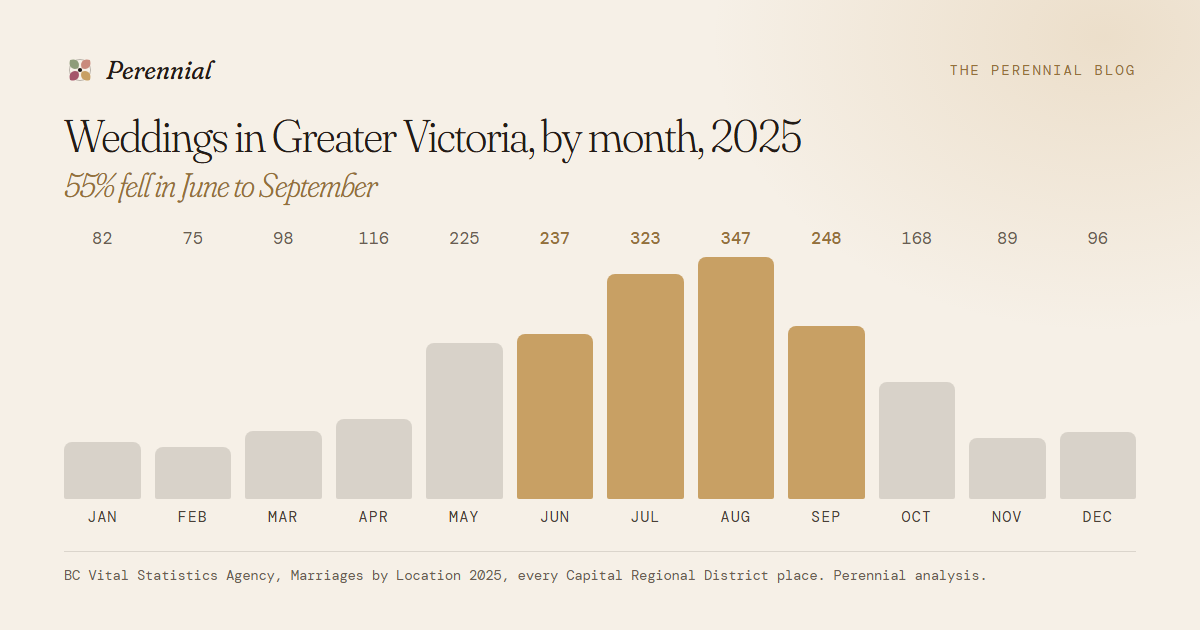
The yearly total is wrong because weddings don’t arrive evenly. In 2025, Greater Victoria held 2,104 weddings, and 1,155 of them, 55%, fell between June and September Our analysis. That is every place in the Capital Regional District, summed from the BC Vital Statistics Agency’s monthly tables in our research paper on the season.
August alone held 347 weddings, about 78 a week, while February held 75 for the whole month Our analysis. That is a gap of 4.6 times. Stretch the window to May through October and it covers 74% of the 2,104.
So a planner who books 20 weddings at the regional rate gets about 11 of them in four months. The year has room. The summer doesn’t.
Does the season’s shape change from year to year?
The season’s shape barely changes. June to September held 58% of Greater Victoria’s weddings in 2023, 57% in 2024 and 55% in 2025 Our analysis. The yearly totals hardly moved either: 2,078, then 2,082, then 2,104. A planner can count on the same summer peak every year.
British Columbia follows the same curve. In 2025, 52% of the province’s 28,223 weddings fell in June to September, and August was the busiest month in 2023, 2024 and 2025 Our analysis.
That makes the summer rush the most predictable thing in the business. You can plan it like a production, months before it arrives.
How many Saturdays does a peak season actually hold?
A peak season holds 17 Saturdays. There are 17 between 1 June and 30 September in 2025, 2026 and 2027 alike. If your rule is one wedding a weekend, your summer holds 17 weddings at most. That cap holds before you count Fridays, Sundays or a second team.
Two of the 38 Greater Victoria planning websites we read state a rule like that: one wedding per weekend, and one booking per day Our analysis. Fridays and Sundays add room, and they cost something. A second rehearsal, a second round of vendor confirmations and a Monday you don’t get back all come out of the same week.
How big are the teams carrying the season?
The teams are small. Of 33 Greater Victoria planning businesses whose website shows who does the work, 15 are one person and 7 are two or three Our analysis. Among wedding-led studios, 15 of the 22 with a visible team are three people or fewer. The only teams of ten or more are corporate or destination firms.
In a team of one, the person answering Tuesday’s enquiry is the person at Saturday’s ceremony. That is why the peak weeks, not the client count, decide how many weddings you can take.
The Perennial August Test: how do you set your own number?
Set your number from the bottom up, starting with your busiest fortnight rather than the year. The test takes an afternoon with last season’s calendar, and it works for a team of one or a team of five. Five steps do it.
- Count the peak Saturdays you will work. There are 17 from June to September, so subtract the ones you are keeping for yourself.
- Decide how many weddings your team can staff on one weekend. For most teams of one to three, the honest answer is one, or two with a trusted day-of lead.
- Price each booking in hours by service. Use your own records if you keep them, or the estimates in the table until you do.
- Check the busiest fortnight, not the month. Add up the hours of every wedding and final meeting in those two weeks, and compare them with the hours you really have.
- Decide where the overflow goes before January: a planner you trust, a weekday or off-season date, or a short waitlist.
Here is the arithmetic for a solo planner doing only full planning, one wedding a weekend. Seventeen weddings at about 100 hours each, inside the institute’s 80 to 150 estimate, is roughly 1,700 hours Our analysis. That is close to a full-time year of work for one person, before a single wedding outside the summer.
The admin in those weeks is the part we take off a planner’s plate. That means a Monday briefing across every event in flight, and clients chased for headcount, dietary needs and seating. It also means limits that stop the calendar overfilling. It is the Run phase in our packages.
What do local planners say about capacity on their websites?
Local planners say very little about capacity. Thirteen of the 38 Greater Victoria planning sites we read say anything about availability Our analysis. None says how many events it takes in a year. Couples are left to guess whether a date is still open.
Most give a booking window, such as “now booking 2026 and 2027”, or say the season is full. One reads “May thru end of October, 2026 is fully booked.” One island studio has turned its limit into a product: its weekends go to full weddings, and its weekdays go to elopements.
Saying your limit out loud helps the right clients book early. It also tells the couple who wants a July Saturday to enquire now, not in March.
What should you do with enquiries past your limit?
Turn enquiries past your limit into something other than a no. A couple who can’t have your August Saturday may still want a Friday, a quieter month or a planner you trust. Each of these keeps the relationship and some of the revenue.
- Refer them to a planner you trust, and agree any referral fee in writing first.
- Offer a Friday, a weekday or an off-season date, which is where the quiet months start to earn.
- Keep a short waitlist for the dates that open up when plans change.
The quiet months are also when the pages that bring next year’s clients get written. Our post on how wedding planners get recommended by ChatGPT covers which pages those are. A published price helps too, because it means the enquiries that do arrive already fit: see whether wedding planners should put prices on their website.
Key Takeaways
- The yearly total is the wrong limit, because 55% of Greater Victoria’s 2,104 weddings in 2025 fell in June to September (BC Vital Statistics).
- The shape repeats every year, with June to September holding 58%, 57% and 55% of weddings in 2023, 2024 and 2025.
- Most local teams are small, since 22 of 33 Greater Victoria planning businesses with a visible team are three people or fewer.
- A summer holds 17 Saturdays, so a rule of one wedding a weekend caps the peak at 17 weddings.
- Count the hours in your busiest fortnight, and decide where the overflow goes before January.
FAQ
What is the rarest month to get married?
In Greater Victoria it was February in 2025, with 75 of the year’s 2,104 weddings. January and November came next, with 82 and 89.
What is the most popular month to get married in Canada?
We can speak for British Columbia, where August was the busiest month in 2023, 2024 and 2025. In Greater Victoria, August held 347 of 2025’s 2,104 weddings. We haven’t checked the other provinces.
Is being a wedding planner a stressful job?
It can be, and the stress is seasonal. More than half of a year’s weddings land in four months, and most local studios have three people or fewer to carry them. Planning the peak months ahead is the best fix we know.
What are the downsides of being a wedding planner?
The biggest one in the data is the season. Summer weekends fill up and the work arrives in a rush. The quiet months earn less unless you use them to sell next season, off-season dates and corporate work.
Is 12 months enough time to plan a wedding?
For most couples, yes, and many start around then. The Knot found 52% of US couples began planning 12 months ahead, and Zola puts the average engagement at 18 months. That means couples marrying next August are choosing planners this winter.
Bottom Line
You can take as many weddings as your team can carry in its busiest fortnight, not as many as the year can hold. Count the 17 Saturdays, price the hours, and decide the overflow before January. If you would like a second pair of eyes on next season, tell us how full it looks.
Sources
- BC Vital Statistics Agency, Marriages by Location reports, 2023 to 2025: monthly marriages by place, the source of every Greater Victoria and BC figure.
- Perennial research, Paper 03: The August problem: the Capital Regional District totals, team sizes and capacity statements from 38 websites, 16 October 2026.
- Wedding Planning Institute, Wedding Planner Salary Guide 2026: hours per wedding and weddings a year, as the publisher’s estimates.
- The Knot, Weddings in 2024: engagement length and when US couples start planning.
- Zola, The First Look Report 2026: average engagement length.