TL;DR: In Victoria, ChatGPT built its list of the best wedding planners from two directories. None of the eight names came from a planner’s own website. Claim and complete the directories the engines read, then publish the pages they couldn’t find on your site. OpenAI’s new Business Hub manages your listing, but OpenAI says claiming doesn’t guarantee more visibility.
How do you get recommended by ChatGPT as a wedding planner? Start with where it looks. When we asked ChatGPT for the best wedding planners in Victoria, BC, it named eight, and seven of them, 88%, came from two directories Our analysis. None came from a planner’s own website. So the work is two jobs: be on the pages the engines read, and publish the answers they can’t find anywhere else.
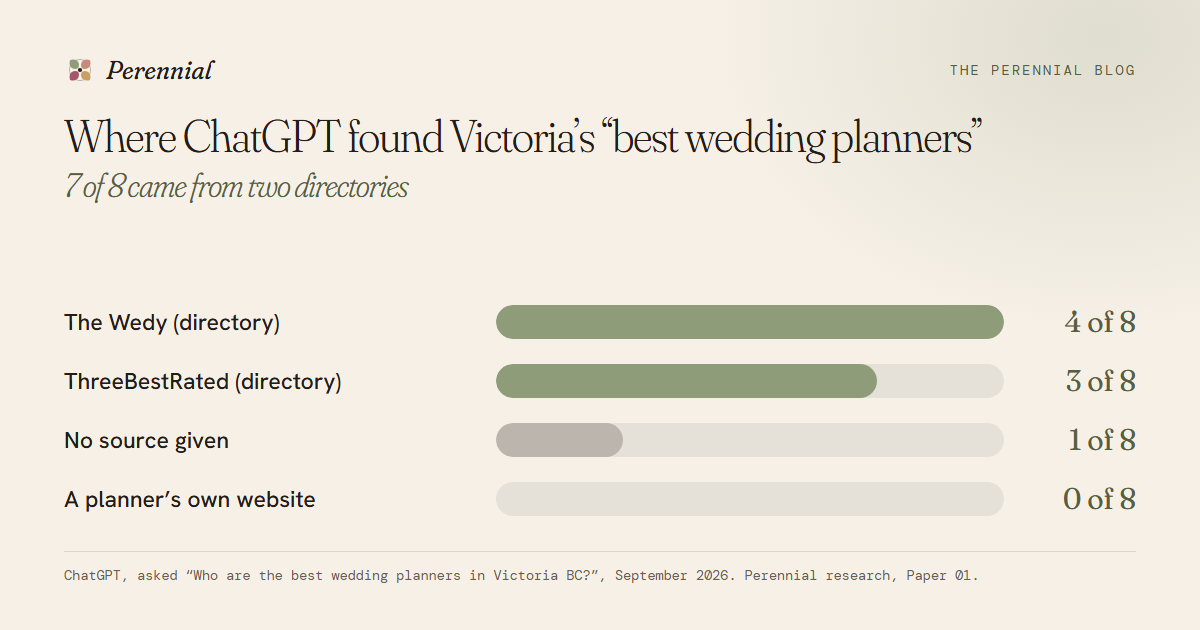
Where does ChatGPT get its wedding planner recommendations?
ChatGPT gets its recommendations from pages other people publish about you. In September 2026 we asked it “Who are the best wedding planners in Victoria BC?” It named eight planners: four sourced to The Wedy, three to ThreeBestRated, and one with no source at all Our analysis.
Not one of the eight was quoted from a planner’s own website. One answer is a small sample, and answers change from day to day. Still, it shows where the engine looked first. The full trace is in our research paper on AI answers.
Does Perplexity build its list the same way?
Perplexity builds its list mostly the same way. On 16 October 2026 it read ten pages to answer the same question, and eight were directories and quote sites Our analysis. One was another vendor’s guide, and one was a planner’s own website.
It even justified one pick with a directory’s note that the planner was “noted to respond within 24 hours”. Directories don’t only list you. They describe you, and the engines repeat the description.
The pattern reaches well beyond weddings. In BrightLocal’s study of local searches in the US, UK and Australia, Yelp was a source in 80% of ChatGPT’s answers Outside source. Not every test agrees for planners, so check your own city before assuming.
When does a planner’s own website get quoted instead?
A planner’s own website gets quoted when the directories are thin. We also asked Perplexity about corporate event planners in Victoria, and four of the five businesses it named were cited to their own websites Our analysis. For wedding planners, it was one of five.
Wedding directories are crowded, and corporate ones mostly aren’t. Where the directories are thin, the clearest page on your own site wins. One of those corporate picks was quoted from a page written for exactly that question.
What does an engine find on a planner’s website?
An engine finds less than it needs on most planner websites. We read all 38 Greater Victoria planner websites on 16 October 2026, and this is what they offered a crawler. Each row is a page or file an AI tool could have quoted.
| What the website has | Greater Victoria planners |
|---|---|
| A blog post in the past 12 months | 8 of 38 |
| Code telling search engines it is a local business | 14 of 36 we could load in full |
| Its own llms.txt, a plain summary for AI tools | 0 of 38 (9 have one their platform made) |
| A price, answering the cost question | 17 of 38 |
| A page about corporate events | 13 of 38 |
| A page about a specific venue | 4 of 38 |
The good news is that nothing was blocking the engines. The gap is content, not access.
Should you claim your business in ChatGPT’s Business Hub?
Claim it if you can, but don’t expect it to change what ChatGPT recommends. OpenAI’s Business Hub lets an owner claim a listing and keep its details current. It also shows insights such as mentions and website clicks over the past 28 days.
OpenAI’s own Help Center is plain about the limits. Claiming “doesn’t guarantee increased visibility”, and advertising doesn’t influence ChatGPT’s independent answers. It also says ChatGPT may use other sources when answering questions about your business, which brings you back to the directories.
There is a catch for Canadian planners. OpenAI says local stores and restaurants can currently claim only an existing US listing, and availability depends on location and type of business. Check Business Hub from your own ChatGPT account before you count on it.
Which directories should a Canadian planner claim first?
Claim the directories the engines actually quoted. In Victoria that meant The Wedy and ThreeBestRated, then WeddingWire. Start with the two that supplied seven of ChatGPT’s eight names. A complete profile there describes you in your own words instead of a stranger’s.
- The Wedy. It is free to claim, and its Victoria list is ordered by Google review count. None of its 15 Victoria planner profiles had been claimed when we checked in October 2026 Our analysis.
- ThreeBestRated. ChatGPT took three of its eight Victoria names from it.
- WeddingWire. Perplexity read two of its pages for a single answer.
- Google Business Profile and Bing Places. OpenAI says ChatGPT search uses outside search providers, and Microsoft is one of them. A complete Bing listing is cheap insurance.
The Knot now has an app inside ChatGPT, but its launch covered US vendors only, so it doesn’t help a BC planner yet. Reviews matter on every one of these lists; our paper on reviews shows how The Wedy ranks them.
Claiming and completing these profiles is the first job in our Ranked package, along with the structured data and llms.txt that go with them.
The Perennial Source Trail: how do you check what the engines say about you?
Check what the engines say by asking them the way a client would, then tracing every source. Do it signed out, so your own history doesn’t shape the answer, and write down what you find each time. Six steps cover it.
- Ask the three questions a client asks: the best planners in your city, what a planner costs there, and the best corporate planners there. Sign out and start a fresh chat.
- Ask for the same answer again as a list with every source URL.
- Sort each source into a directory, another vendor, or your own page.
- Claim and complete the top two directories on that list.
- Write the one page of your own that the cost or corporate answer was missing.
- Repeat every month and keep a log, because the answers change.
What should your own pages say so an engine can quote them?
Your own pages should state the facts a client asks for, in plain sentences, on pages with their own address. When Victoria planners didn’t publish a price, Perplexity answered the cost question from a page about Victoria-Fraserview, a neighbourhood in Vancouver Our analysis. That was one answer on one day, but it shows what fills the gap.
We cover the fix in whether wedding planners should put prices on their website. The pages that worked for corporate planners were a price page, a corporate page and pages about specific venues.
Testimonials help most when they name the venue and the town. Only 7 of the 183 testimonials on Victoria planners’ own websites did Our analysis. Write all of this in the quiet months. Our post on how many weddings a planner can take shows when those are.
How long does it take to get recommended by ChatGPT as a wedding planner?
It takes months, not days, and nobody can promise you a place in an answer. Answers change by day and by person, and our Victoria sample was four answers in all. Treat any promise of a quick place in ChatGPT as a warning sign.
Directory profiles, reviews and clear pages build on each other over time. The planners who start this winter are the ones the engines find next season.
Key Takeaways
- ChatGPT took 7 of the 8 Victoria planners it named from The Wedy and ThreeBestRated, and none from planners’ own websites (Perennial, September 2026).
- Own pages win where directories are thin, as 4 of the 5 corporate planners Perplexity named were cited to their own websites.
- Claim and complete the directories the engines quote before anything else.
- OpenAI’s Business Hub manages your listing, but OpenAI says claiming doesn’t guarantee more visibility.
- Publish the pages engines can’t find elsewhere: your price, the venues you know and your corporate work.
FAQ
Can ChatGPT generate leads?
It can, indirectly. Zola’s First Look Report 2026 found 54% of US couples planning weddings use AI in some way, though The Knot puts it at 36%. When ChatGPT names you, the lead arrives as a website visit or an enquiry.
What is a ChatGPT business profile?
It is your business’s listing inside ChatGPT, managed through OpenAI’s Business Hub. After you claim it and pass an identity check with Persona, you can update your details and see mentions and website clicks.
How do I get my business to show up in AI searches?
Be on the directories the engines read, and keep your Google Business Profile and Bing Places listing complete. Then publish clear pages that answer what clients ask, and check the answers every month with the Source Trail.
Does ChatGPT use Bing?
Partly. OpenAI says ChatGPT search uses outside search providers, and Microsoft is one of them. A complete Bing Places listing is worth a few minutes, but Bing isn’t ChatGPT’s only source.
Do wedding planners need an llms.txt file?
It helps and costs little. An llms.txt is a plain summary of your site for AI tools, a proposed standard rather than a requirement. None of the 38 Greater Victoria planner websites we read had written its own.
Bottom Line
Getting recommended by ChatGPT starts on other people’s pages and ends on yours. Claim the directories the engines read, publish the answers they can’t find, and check the results every month. If you would like us to run the Source Trail on your city, get in touch.
Sources
- Perennial research, Paper 01: Who the machines name: the ChatGPT and Perplexity answers, and the crawl of 38 planner websites.
- OpenAI Help Center, Setting up your business on ChatGPT: Business Hub, who can claim, and what claiming does not do (read 17 November 2026).
- OpenAI, Introducing ChatGPT search: ChatGPT search uses third-party search providers.
- BrightLocal, Top sources and directories for local AI search: Yelp as a source in 80% of ChatGPT’s local answers (US, UK and Australia).
- Zola, The First Look Report 2026: AI use among US couples.
- The Knot Worldwide, The Knot’s app within ChatGPT: the app covers US vendors.
- llmstxt.org: the proposed llms.txt standard.
- Perennial research, Paper 04: The review nobody asked for: The Wedy’s ranking and testimonials that name the venue.